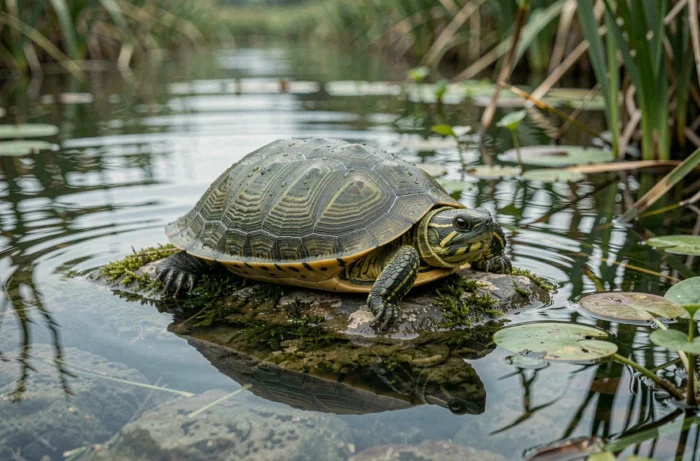
The cloacal respiration of aquatic turtles is not just a barroom anecdote. It is a complex physiological mechanism that fits into a broader strategy of extra-pulmonary gas exchange, involving several organs and a complete overhaul of metabolism during winter submersion.
Diffusive gas exchange: why the cloacal mucosa absorbs dissolved oxygen
The inner wall of the cloaca in some freshwater turtles is lined with richly vascularized papillae. These structures function as a secondary respiratory membrane: the dissolved oxygen in the water passes through the epithelium by passive diffusion and enters the bloodstream.
The mechanism relies on a partial pressure gradient of oxygen between the surrounding water and venous blood. The animal actively pumps water through rhythmic contractions of the cloaca, renewing the medium in contact with the mucosa. This cloacal pumping has been documented in several species, including the painted turtle and some softshell turtles.
We observe that the turtle that breathes through its anus actually uses a set of complementary exchange surfaces. The skin, pharynx, and buccal mucosa simultaneously participate in oxygen absorption. The cloaca is just one site among others in this extra-pulmonary respiration.
Winter bradymetabolism and anoxia tolerance in freshwater turtles
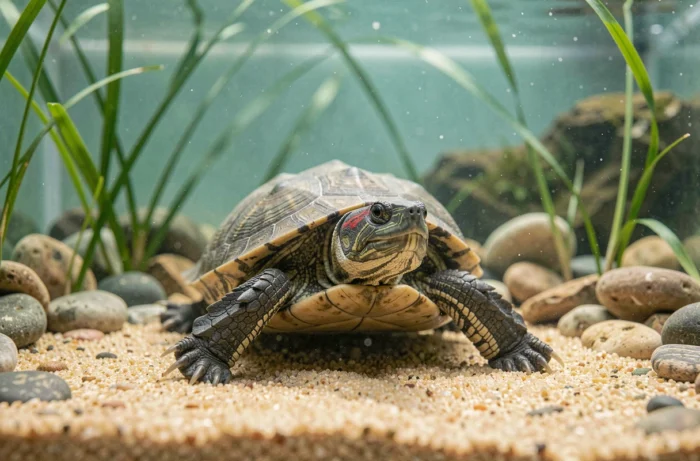
To survive for several months under the ice, aquatic turtles do not just breathe differently. They reduce their metabolism to near-zero levels, a state known as bradymetabolism.
This drastic drop in metabolic activity decreases the oxygen demand to the point that cutaneous and cloacal gas exchanges are sufficient to meet residual cellular needs. Heart rate slows significantly, digestion stops, and the animal enters a state of prolonged torpor.
When the water becomes very low in oxygen, some species switch to anaerobic metabolism. This shift generates lactic acid in quantity, causing progressive acidosis in the tissues. This is where a remarkable mechanism comes into play.
Role of the shell and skeleton as a chemical buffer
To neutralize the acidosis associated with anaerobic metabolism, the painted turtle mobilizes calcium and magnesium carbonates directly from its shell and skeleton. These minerals act as a chemical buffer, stabilizing blood pH for weeks.
The shell thus serves as an anti-acidosis mineral reservoir, and not just as mechanical protection. This dual role, structural and biochemical, distinguishes turtles from most other vertebrates faced with prolonged anoxia.
Species involved in cloacal respiration: painted turtle, softshell turtle, and Mary River turtle
Not all turtles practice cloacal respiration with the same efficiency. The most well-documented species share certain anatomical characteristics.
- The painted turtle (Chrysemys picta) combines cloacal, cutaneous, and buccal respiration to hibernate under the ice for several months without access to the surface.
- Softshell turtles (family Trionychidae) have particularly thin and vascularized skin, which amplifies transcutaneous gas exchanges in addition to the cloacal route.
- The Mary River turtle (Elusor macrurus), an endangered Australian species, is known for its ability to remain submerged for a very long time thanks to particularly developed cloacal respiration.
In these species, the cloacal exchange surface is proportionally larger and better irrigated than in terrestrial turtles, whose cloaca primarily serves reproductive and excretory functions.
Cloacal respiration and biomedical research: a model for anoxia tolerance
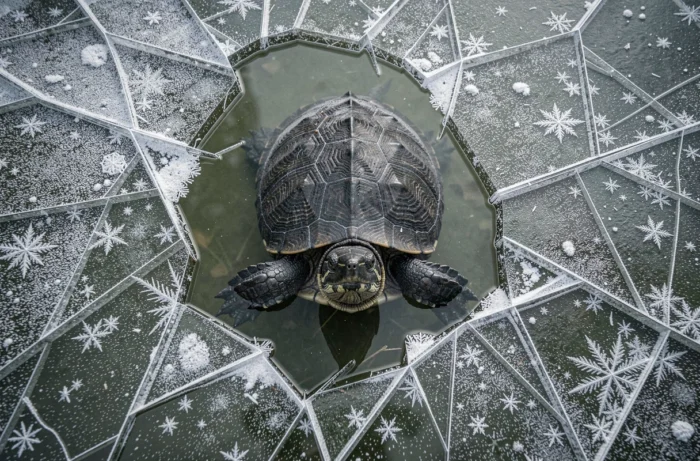
The ability of turtles to survive without oxygen for prolonged periods is of interest to biomedical research. Understanding the metabolic pathways that allow this tolerance could open avenues for human emergency medicine, particularly in ischemic situations (stroke, cardiac arrest).
Recent work explores the molecular mechanisms of this resistance. Painted turtles are among the most anoxia-tolerant vertebrates, capable of maintaining their cellular functions under conditions where most mammals would suffer irreversible damage within minutes.
The study of cloacal respiration thus falls within a much broader field than descriptive zoology. It touches on the biology of cellular survival, the management of oxidative stress during reoxygenation, and the limits of aerobic metabolism in vertebrates.
A multi-organ strategy, not just a “weird trick”
Reducing cloacal respiration to an anatomical curiosity misses its true biological interest. This mechanism is part of an integrated system where lungs, skin, pharynx, buccal mucosa, and cloaca form a network of gas exchanges that can be modulated according to environmental conditions.
During active periods, the lungs provide the majority of oxygenation. In prolonged submersion or hibernation, the relay gradually shifts to extra-pulmonary pathways, with the cloaca as a significant contributor in adapted species.
This respiratory plasticity partly explains why aquatic turtles occupy ecological niches inaccessible to other reptiles. Their ability to modulate their gas exchange sites according to context constitutes a major adaptive advantage, forged by millions of years of evolution in seasonal aquatic environments.