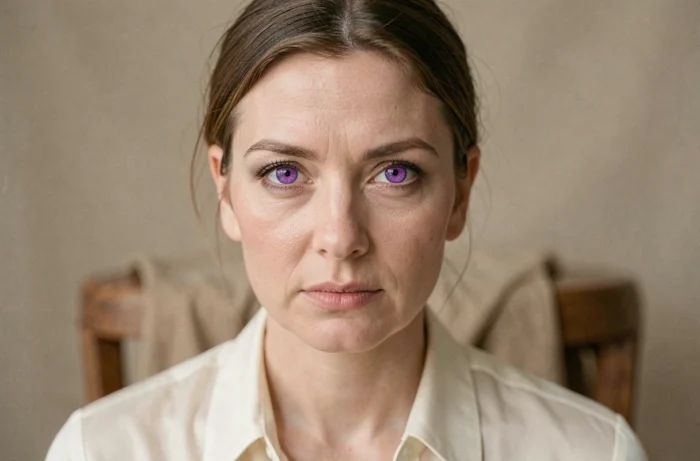
Purple eyes have fascinated cinema for decades. Elizabeth Taylor remains the face associated with this iris color, and the question arises regularly: is there a purple pigment in the human eye, or is it an illusion maintained by lighting on set and Hollywood mythology? The answer lies at the intersection of optics, genetics, and a long history of staging.
Melanin and Light Scattering: Why No Iris is Purple
The human iris contains only two types of pigments: eumelanin (brown-black) and pheomelanin (brown-red). No purple pigment exists in the human eye. The perceived color depends on the amount of melanin and how light passes through the layers of the iris stroma.
Very light eyes, low in melanin, scatter light in a manner similar to Rayleigh scattering, the same phenomenon that makes the sky blue. When the layer of melanin is extremely thin and the blood vessels of the iris slightly show through, the deep blue can take on a reddish hue. The visual mix of blue and red then gives a purplish impression.
This shade remains an optical impression related to lighting conditions, not an autonomous pigment category. No ophthalmologist classifies purple among iris colors in a standard clinical examination.
The subject has long fueled speculation, and many articles dedicated to actresses with natural purple eyes struggle to distinguish visual perception from biological reality.

Elizabeth Taylor and the Color Purple: What the Elizabeth Taylor Estate Says
Elizabeth Taylor is mentioned in almost all articles about purple eyes. Her irises appeared sometimes deep blue, sometimes distinctly purple depending on the films and photographs. The variation was due to several technical factors: Technicolor film, studio lighting, makeup designed to enhance the contrast with her irises.
The Elizabeth Taylor Estate clarified that the color of her eyes corresponded to a mix of very deep blue and green, which could be perceived as purple under certain conditions. No medical measurement has demonstrated the presence of a distinct purple pigment in the actress.
This clarification contradicts part of the legend. Taylor likely had an unusually low concentration of melanin, combined with a stroma structure that favored this unique hue. The perceived purple was real for the observer, but it did not exist as a pigment in the iris.
The Role of Technicolor and Post-Production
Early Technicolor films saturated colors dramatically. A deep blue could shift towards purple on screen without any intentional retouching. The cinematographers who worked with Taylor were aware of this effect and exploited it.
Press photographs, often hand-retouched at the time, further reinforced this perception. The myth of Taylor’s purple eyes is as much a technical product as it is an optical phenomenon.
Alexandria’s Genesis: A Viral False Syndrome
Since the 2000s, a supposed syndrome called “Alexandria’s Genesis” has circulated on forums and some popular science websites. According to this urban legend, some people are born with purple eyes, sun-resistant pale skin, a lack of body hair, and an extended lifespan.
- No referenced scientific publication has documented this syndrome in a peer-reviewed journal
- The term has been traced back to an online fiction published in the 1990s, later taken up as a medical fact
- Several fact-checking sites have classified Alexandria’s Genesis as a complete fabrication, with no genetic or clinical basis
This pseudo-diagnosis is often invoked in articles claiming that actresses or celebrities possess natural purple eyes. Alexandria’s Genesis is not a recognized medical diagnosis. Its online success illustrates how easily an aesthetic myth can acquire a scientific veneer.

Purple Eyes and Ocular Albinism: The Only Documented Case
The only medical context in which an iris can actually appear purple or reddish is ocular albinism. In individuals with this condition, melanin is absent or nearly absent from the iris. Light then passes through the stroma and reaches the retina, whose blood vessels give a red or pinkish reflection.
This red, combined with the residual blue from light scattering in a depigmented iris, can produce a purplish hue. However, this appearance is usually accompanied by marked photosensitivity and visual disturbances, which is far from glamorous.
People with purple eyes represent less than 1% of the global population, and most of these cases are related to forms of albinism or extremely light irises photographed under specific lighting conditions.
What Cinema Maintains and What Science Limits
Cinema needs mystery, and purple eyes provide a particularly photogenic one. Colored contact lenses, makeup, and digital post-production now allow any actor to have irises of the desired color. The boundary between natural and artificial has never been so porous on screen.
On the scientific side, the current consensus is clear: purple is not an autonomous iris color. No robust clinical case of pure purple iris, independent of albinism or particular lighting, is established in the ophthalmological literature. The available data do not allow for the conclusion of the existence of a distinct genetic category for this color.
Elizabeth Taylor’s eyes were remarkable, and the purple perception that millions of viewers observed was authentic as a visual experience. Distinguishing it from a biological pigment does not detract from her beauty, but places the discussion on verifiable ground. The purple of the eyes remains, for now, a phenomenon of light and gaze, not of genetics.