
The black wire and the white wire coexist in most domestic cables, but their roles change radically depending on the country, the time of installation, and the electrician’s choice. In France, the NF C 15-100 standard governs the color code of conductors. Black indicates a phase wire, while white is part of the so-called “free” colors, usable for phase or control circuits.
This ambiguity of the white wire, often confused with neutral due to North American habits, leads to wiring errors that can sometimes have serious consequences.
Live white wire: a confusion linked to North American standards
The majority of online tutorials regarding the connection of white and black wires come from American or Canadian sources. In these countries, the white wire is conventionally the neutral conductor, and the black wire is the “hot” (live) conductor. The National Electrical Code (NEC) does allow the use of the white wire as a phase conductor, provided it is re-identified at the ends with black or red tape.
In France, the logic is different. The neutral is exclusively blue according to NF C 15-100. A white wire can never serve as neutral in a compliant installation. If you open a junction box and find a white wire, it is probably live: phase, lamp return, or traveler in a two-way switch.
Understanding the connection of the white and black wires therefore requires first checking which normative reference the installation was carried out under, before touching anything.
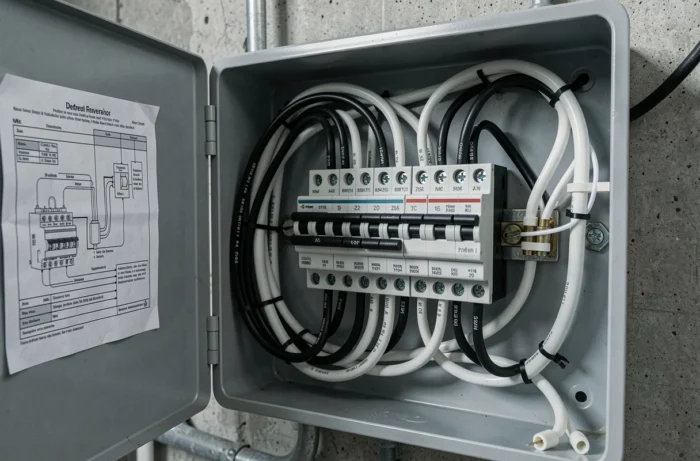
Color code of electrical wires in French domestic installations
The color code imposed by the NF C 15-100 standard is based on three categories of conductors, each associated with strict or free colors.
- The earth wire is mandatory green and yellow. This color is reserved: no other conductor can use it, regardless of the circuit.
- The neutral wire is exclusively blue (light blue). Again, this color is reserved for it and cannot be used to identify another conductor.
- The phase wire can be red, brown, black, gray, orange, purple, white, or pink. Any color is allowed, except blue and green-yellow.
Both black and white are therefore potential phase conductors. Black is frequently chosen as the main phase in standard cables. The white wire, less common, is often used to distinguish a lamp return or a traveler in a two-way switch setup.
Black wire in single-phase and three-phase
In single-phase, the black wire serves the same function as a red or brown wire. The choice depends on the cable used and the installer’s habits.
In three-phase, the common convention assigns brown to phase L1, black to phase L2, and gray to phase L3. The black wire identifies the second phase in three-phase, making it particularly common in distribution boards supplying high-power equipment.
Old installations: black wire was neutral before 1970
The confusion surrounding the black wire does not only stem from the North American context. In France itself, installations carried out before around 1970 used a different color code. Red served as phase and black designated neutral in the old French color code.
This historical inversion poses a concrete risk during renovation work. A black wire in a house built in the 1960s may be a neutral, while the same black wire in a recent installation is a live phase. Without verification, a wiring error can cause a short circuit or electric shock.
How to identify a wire with certainty
Color alone is not enough to guarantee a conductor’s function, especially in an old home or one that has undergone multiple interventions. Two tools can help clarify doubts:
- The multimeter, set to AC voltage mode, measures the potential difference between the tested wire and ground. A phase wire shows a voltage close to the nominal value of the network.
- The tester screwdriver (neon screwdriver) detects the presence of voltage on a conductor. It remains a basic indicator that does not replace precise measurement with a multimeter.
- Visual identification at the electrical panel, tracing each circuit from the circuit breaker, allows confirmation of the correspondence between color and function for each wire.
If there are persistent doubts about an old installation, calling in a professional remains the only reliable approach. An electrical diagnosis identifies non-conformities and allows for planning compliance upgrades.

Common mistakes when connecting the black and white wires
The first mistake is applying the North American color code to a French installation. Connecting a white wire to the neutral terminal of a device while it serves as a lamp return creates an incorrect circuit. The lighting may appear to work, but the differential protection may fail to operate in case of a fault.
The second mistake concerns the travelers in a two-way switch. In a standard setup, two wires of different colors connect the two switches. The white wire often serves as a traveler in a two-way switch, meaning it is alternately live or not depending on the position of the switches. Confusing it with a neutral during connection disrupts the entire control circuit.
The third trap: connections in a three-phase electrical panel. Swapping the black wire (phase L2) with the blue neutral on a circuit departure causes an imbalance between the phases, with consequences for the connected devices.
White wire and black wire: check before connecting
The color code of electrical wires provides an indication, not a certainty. The color of a conductor says nothing about its actual state if the installation has been modified, if it dates from before 1970, or if a previous worker used a reclaimed wire. Before each connection, turning off the power at the main circuit breaker, then testing each conductor with a multimeter remains the sequence to follow. A correctly identified black or white wire means a circuit that operates safely.