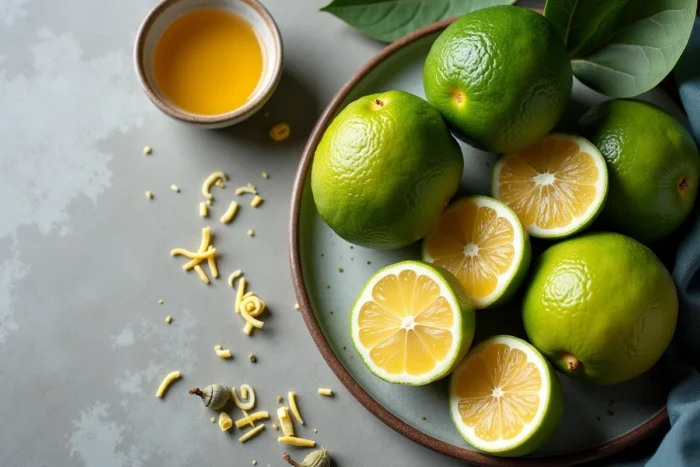
The sudachi remains a little-known citrus fruit in France, far from the notoriety of yuzu. Originating from Tokushima Prefecture in southern Japan, this small green citrus is harvested before ripening for its very acidic juice. Its aromatic profile lies between lime and mandarin, with a freshness that is less aggressive than that of classic lemon.
Understanding how this juice behaves in cooking, and especially where it makes a difference, requires going beyond traditional Japanese uses.
Aromatic profile of sudachi and differences with lime
The comparison with lime is often made, but it deserves clarification. Sudachi juice offers a sharp acidity, accompanied by a floral note reminiscent of mandarin that disappears in classic lime. This aromatic complexity explains why Japanese grocery stores in France and Europe position it as a high-end alternative for dressings, grilling, and mixology.
However, sudachi does not replace lime in all contexts. Its more delicate flavor gets lost in very sweet preparations or long marinades where raw acidity dominates. It delivers its best results added at the end of cooking or raw, when its volatile aromas remain intact.
To delve deeper into Japanese sudachi juice in cooking, the seasonality of the fruit plays a crucial role: harvested green at the end of summer, it yields a livelier and more fragrant juice than that from ripe fruits.

Freezing sudachi juice: the little-known Japanese technique in France
French-speaking content rarely addresses the fractional preservation of sudachi juice, while it is a common practice in Japan. The most widespread method involves squeezing fresh fruits and then freezing the juice in ice cube trays. Each cube represents a calibrated dose, ready to be added directly to a hot dish or drink.
This approach solves a concrete problem: fresh sudachi is only available for a few weeks each year. By freezing the juice right after harvest, one has a stock usable for several months without significant loss of aroma.
Three direct uses of sudachi cubes
- Drop a cube into a bowl of miso shiru just before serving. The juice melts upon contact with the hot broth and adds a light acidity that enhances the dashi without overpowering it.
- Add one or two cubes to diluted soy sauce to create homemade ponzu in seconds, without having to measure the juice each time.
- Place a cube on still-steaming white rice. The juice seeps into the grains and creates a fragrant base for chirashi or a vegetable bowl.
Freezing half-cut fruits also works. Taken out of the freezer a few minutes before use, they can be easily squeezed and release juice almost identical to fresh juice.
Sudachi in soups and broths: a subtle umami enhancer
The pairing of sudachi with Japanese soups is not limited to miso shiru. In dashi-based broths, a few drops of juice added off the heat create an acid-umami contrast that amplifies the perception of depth in the broth. This mechanism is comparable to that of rice vinegar in certain Chinese soups, but with a more subtle result.
On cold udon or soba noodles, sudachi is a great substitute for lemon. The juice does not mask the flavor of the seaweed or the dipping broth, unlike yellow lemon, whose acidity can dominate. Restaurants in Tokushima serve a signature dish of cold noodles drizzled with sudachi, proving that the pairing is validated by local usage.
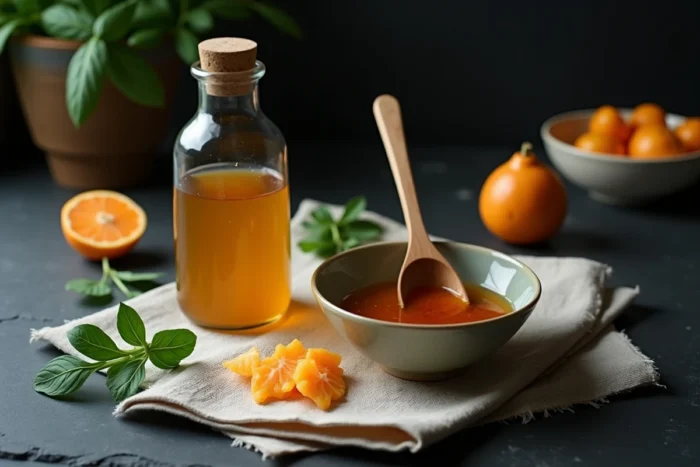
In Western cooking, the same principle applies to vegetable veloutés. A zucchini or pea velouté, seasoned with a drizzle of sudachi juice at serving time, gains liveliness without veering into a pronounced “lemony” taste.
Sudachi in mixology and non-alcoholic drinks
Sudachi juice fits into cocktails and refreshing drinks with a simple logic: it replaces lime wherever a more aromatic and less biting result is desired. In a gin and tonic, a few drops are enough to alter the glass’s profile without adding sugar.
For non-alcoholic drinks, the most straightforward option is the “neo diabolo”: sparkling water, a frozen sudachi juice cube, and possibly a touch of light syrup. The result strays from industrial soda due to its freshness and complexity.
Two precautions in mixology
- Sudachi juice loses its floral aromas with prolonged contact with strong alcohol. It is better to add it at the last moment, as a finishing touch, rather than letting it macerate in the shaker.
- Its acidity, although less aggressive than that of lime, is still sufficient to unbalance a lightly sweet cocktail. Starting with a few drops and adjusting remains the most reliable method.
- In homemade syrups, sudachi works well combined with basil or shiso, two herbs that share its fresh aromatic profile.
Sourcing sudachi juice in France
Finding fresh sudachi in France remains complicated outside the short export season. Specialized Japanese grocery stores offer pure bottled sudachi juice, packaged without additives, which is the most accessible option.
Field reports vary on the quality of bottled juices compared to fresh fruit. Some chefs believe that pasteurized juice loses some of its aromatic complexity, while others find the difference negligible in cooked preparations. For raw use (dressings, finishing fish), fresh fruit or homemade frozen juice provides a clearer result.
Sudachi is unlikely to replace lemon in daily use, if only due to its cost and limited availability. Its value lies precisely in this rarity: a few drops are enough to transform a dish, a broth, or a glass. It is a precision condiment, not a volume citrus.