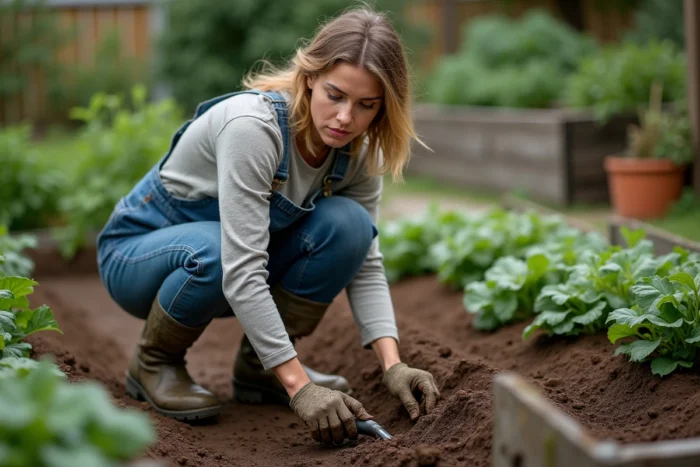
The grelinette is a manual tool with two handles and several steel tines, designed to loosen the soil deeply without turning over the layers. Its mechanism relies on a lever action: the tines are driven vertically into the ground, then rocked back and forth to crack and aerate the soil. This action preserves the natural stratification of the soil, where a spade or tiller mixes the horizons and disrupts the organisms living there.
Grelinette and pore network: what happens beneath the surface
The soil of a vegetable garden functions thanks to a network of galleries and micropores created by earthworms, dead roots, and fungal activity. This network ensures the circulation of air and water to the roots of the crops.
Turning the soil with a spade or tiller destroys this network with each pass. The soil becomes temporarily loose on the surface, but the deep pores are crushed. Within a few weeks, the soil compacts again and forms a hard crust that rainwater struggles to penetrate.
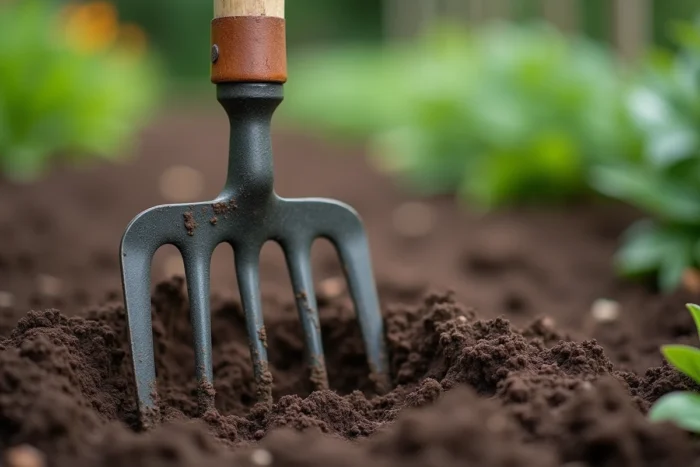
The grelinette cracks the soil without crushing the existing galleries. The tines create vertical slits that add to the natural network instead of replacing it. The result is soil that remains structured longer between interventions. Detailed resources on the models and use of this tool are available at grelinette-warrior.com, which lists different configurations based on soil type.
Resilience of the vegetable garden to droughts and heavy rains
Typical articles about the grelinette mention soil aeration but stop there. The link to resilience against climate hazards deserves further detail.
Drought and water retention
A soil simply loosened with a grelinette retains its natural pores intact. These pores function as capillary reservoirs: they hold water deep down and gradually release it to the roots.
In contrast, soil turned with a tiller loses this capillarity. Water evaporates more quickly from the surface, and roots must dig into a disorganized substrate to find moisture. According to the Soil Association, no-till gardening systems (where the grelinette is used occasionally to crack) show a measurable reduction in runoff and erosion during heavy rain events.
Intense rains and infiltration
When it rains heavily on tilled soil, the surface quickly forms a crust. Water runs off instead of infiltrating, taking surface nutrients with it.
A soil worked with a grelinette maintains a crumbly surface with open cracks. Water infiltrates instead of running off, which limits erosion and recharges deep water reserves. For a vegetable garden, this means less watering and plants that are more resilient to heat stress.
Permanent beds and grelinette: a coherent system
The grelinette makes the most sense in a vegetable garden organized into permanent beds. The principle: fixed cultivation strips, which are never walked on, separated by pathways for circulation.
- The beds are never trampled, so the soil remains loose. The grelinette is used only once or twice a year, at the beginning and end of the season, to restart aeration.
- The mulch (compost, dead leaves, straw) placed on the surface decomposes gradually and nourishes the soil without tilling. Earthworms pull organic matter deep down.
- This grelinette-mulch duo significantly reduces soil working time compared to a traditional vegetable garden where one digs or uses a tiller several times a season.
The organization into permanent beds also allows for planning crop rotations and vegetable associations in stable locations from year to year. The soil structure improves gradually, season after season.
Number of tines and soil type: choosing the right configuration
Not all soils respond the same way to the grelinette. The number of tines and the spacing between them determine the working width and the effort required.
- Three tines: suitable for heavy, clayey soils. Less resistance with each penetration, allowing work without straining on compacted land.
- Four tines: a common compromise for loamy or slightly clayey soils. Reasonable working width, moderate effort.
- Five tines: reserved for light, sandy, or already well-structured soils. The working width is larger, but the total effort increases on hard soil.
A rarely discussed point: the length of the tines determines the depth of loosening. Short tines will suffice for soil maintained each year. Longer tines are necessary for land that has been fallow or compacted for several seasons.
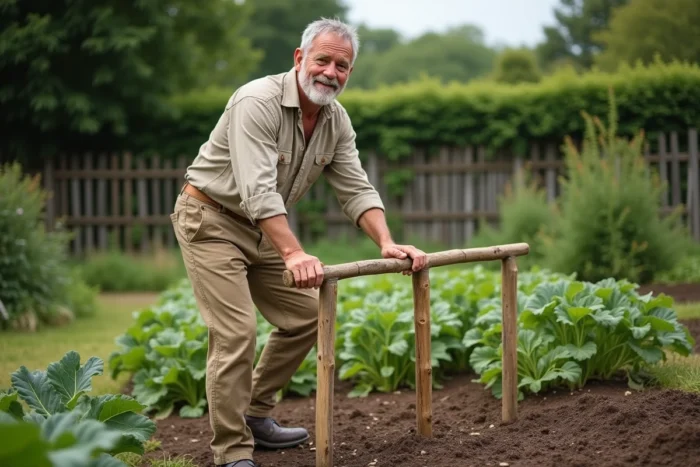
The quality of the steel of the tines also plays a role in durability. Hardened steel withstands stony soils better and retains its shape without bending. Hardwood handles (ash, beech) absorb vibrations better than metal handles, reducing wrist fatigue during long sessions.
Concrete limits of the grelinette in the vegetable garden
The grelinette does not replace all tools. In a fallow area overrun with couch grass or bindweed, the creeping roots pass between the tines without being pulled out. Pre-weeding with a fork or covering with a tarp remains necessary before the first pass.
In very stony soils, the tines frequently hit rocks, and the effort becomes arduous. Beyond a certain density of stones, the grelinette loses its ergonomic advantage compared to a traditional digging fork.
Finally, the grelinette works at surface and medium depth. For crops with very deep roots (artichokes, horseradish), additional loosening with a hoe or fork may be useful after using the grelinette.
A productive vegetable garden relies on living, structured soil that can manage water on its own. The grelinette is the tool that allows maintaining this structure without destroying it each season, provided it is combined with regular mulching and permanent beds. The choice of model depends on the soil, not the brand.