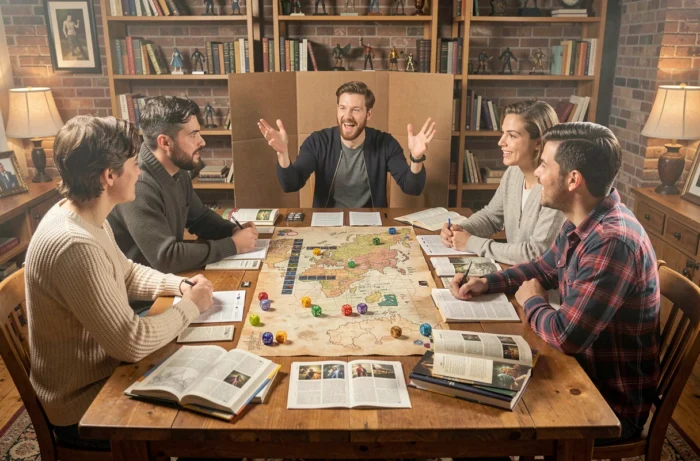
Tabletop role-playing games bring together millions of players each week around a common promise: to build a story together that no one could have written alone. Between the choice of the rule system, the preparation of the game master, and the group dynamics, several parameters determine the quality of a session. Comparing these parameters helps to understand why some tables work better than others.
Fantasy, horror, or science fiction role-playing games: a comparison of major genres
The genre of an RPG influences the pace of sessions, the level of improvisation expected, and the necessary materials. Here is a comparison of the three main families that dominate the French-speaking market.
| Criterion | Fantasy (e.g., Dungeons & Dragons, Chroniques Oubliées) | Horror (e.g., Call of Cthulhu) | Science Fiction (e.g., Alien RPG) |
|---|---|---|---|
| Average session duration | 3 to 4 hours | 2 to 3 hours | 2 to 3 hours |
| Ideal number of players | 4 to 6 | 3 to 5 | 3 to 5 |
| Learning curve | Medium (detailed combat rules) | Low to medium (focus on investigation) | Low (survival and narrative tension) |
| Replayability of a scenario | High (long campaigns) | Medium (linear resolution) | Medium to high (multiple outcomes) |
| Distinctive accessory | Dungeon maps, miniatures | Mental health sheets | Spaceship cards, stress timer |
Fantasy remains the entry genre for the majority of groups, thanks to comprehensive starter boxes like those of Dungeons & Dragons or Chroniques Oubliées. In contrast, horror games like Call of Cthulhu prioritize atmosphere over mechanics, making them accessible to players who are less comfortable with numbers.
Science fiction attracts an audience looking for licensed universes (Alien, Star Wars). The materials play a more pronounced role: spaceship cards, mechanical stress systems, resource counters. Various references are available on aventureslegendaires.be, across all categories.

The role of the game master: what distinguishes a good table from a failed session
Character creation and system choice occupy a large part of RPG guides. The work of the game master (GM) deserves at least as much attention, as the quality of the GM determines the enjoyment of the game more than the chosen system.
Preparing an RPG scenario without locking it down
A common trap is to write a linear scenario where each scene depends on the previous one. Players almost always deviate from this. Experienced GMs instead prepare independent narrative nodes: locations, NPCs (non-player characters), and triggering events that can occur in any order.
This modular approach reduces preparation time and increases replayability. The same scenario can produce radically different stories depending on the group’s decisions.
Managing the pace during the session
Alternating narrative tension and breathing moments prevents fatigue. In horror, a calm scene before a revelation amplifies the effect. In fantasy, a fight that lasts too long after a negotiation sequence disrupts the pace.
The GM has a simple lever: speaking time. Distributing speaking time fairly among players prevents a dominant profile from monopolizing decisions. Recent systems incorporate scene mechanics that formalize this sharing.
Role-playing games and mental health: recent research data
Beyond leisure, RPGs are the subject of academic studies measuring their effects on psychological well-being. These works provide additional insight into the interest of tabletop role-playing games.
A study published by Merrick, Li, and Miller in the Games for Health Journal documents a significant decrease in symptoms of depression, anxiety, and stress after several weeks of structured role-playing in a community context. Participants also reported an increase in self-esteem and a sense of personal efficacy.
A broad review published by Yuliawati, Wardhani, and Ng synthesized over fifty studies on tabletop RPGs in educational, social, and therapeutic contexts. The conclusions point to possible benefits on psychosocial skills, stress reduction, and social anxiety, while highlighting the methodological weaknesses of most studies.
- Neurodivergent audience: a review by Thompson and Majumder highlights positive effects on communication and shared decision-making among autistic participants, as well as an increased sense of social connection.
- Transferable skills: negotiation, group problem-solving, and managing failure (a failed dice roll) are practiced in every session.
- Structured framework: unlike free play, RPGs impose shared rules and an arbiter (the GM), creating a predictable and safe social space.
Choosing your first role-playing game: concrete criteria for a beginner group
The choice of the first RPG relies less on genre than on three practical criteria that are often underestimated.
The first criterion is the product format. Starter boxes (like those of Dungeons & Dragons or Chroniques Oubliées Fantasy) contain dice, pre-made character sheets, and ready-to-play scenarios. A rulebook alone assumes that the group already has the materials and the time to read several hundred pages.
The second criterion is the duration of commitment. Some RPGs are played in one-shots (a single session), while others are campaigns over several months. A beginner group should test a standalone scenario before embarking on a campaign, to validate compatibility among players.
The third criterion is the availability of the GM. Not all systems require the same level of preparation investment. Some recent games offer “ready-to-play” scenarios with read-aloud sections and simplified decision trees, which reduces the GM’s workload to less than an hour of preparation.
Tabletop role-playing games remain one of the few hobbies where the content is generated by the participants themselves. Recent research confirms that this co-creation produces measurable effects on well-being, far beyond mere entertainment.
The choice of system, genre, and GM shapes the experience, but the regularity of the group remains the most determining factor. A table that meets every week progresses faster than a well-equipped group that plays twice a year.