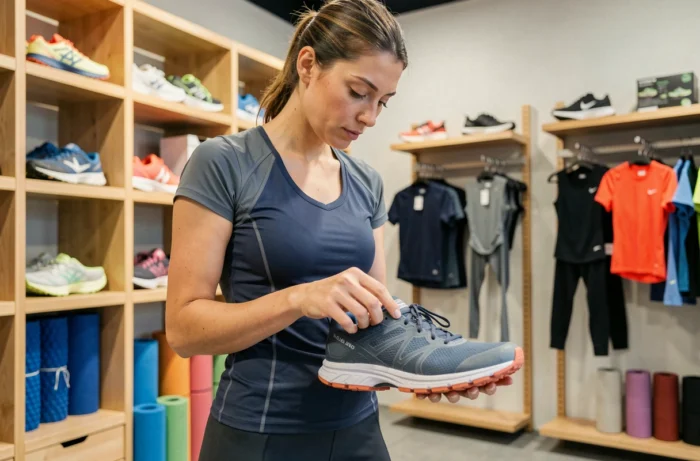
Choosing sports equipment is no longer just about comparing prices or brands. The geometry of a sole, the chemical compliance of a textile, or the possibility of repairing an accessory directly affect the lifespan of the equipment and the comfort of use. This article measures the concrete gaps between traditional selection criteria and those that are gaining ground.
PFAS Compliance and Sports Equipment: The Selection Criterion to Check Starting in 2026
Competing content details comfort, size, or performance. None mention the chemical regulations that directly affect sports clothing, shoes, and accessories. Since January 1, 2026, France has prohibited the sale of clothing, shoes, waterproofing agents, and consumer ski wax containing certain PFAS. An extension to other textiles is planned for 2030.
Specifically, a trail or ski practitioner buying a waterproof jacket or wax must now check that the product complies with this regulation. Manufacturers are reformulating their water-repellent treatments, and not all models in stock are yet compliant.
This criterion adds to the usual characteristics (breathability, weight, cushioning). To compare effectively, here is a summary table of selection criteria according to the type of equipment, incorporating this new regulatory requirement.
| Type of Equipment | Classic Criteria | Regulatory Criterion (PFAS) |
|---|---|---|
| Clothing (jacket, pants) | Breathability, fit, lightness | Check for the absence of PFAS in the water-repellent treatment |
| Running/Trail Shoes | Cushioning, drop, sole stiffness | Compliance of waterproofing treatments |
| Ski Waxes | Glide, application temperature | Prohibition of consumer PFAS-containing waxes |
| Accessories (gloves, bags) | Durability, ergonomics | Progressive compliance by 2030 |
A high-performing but non-compliant piece of equipment risks being withdrawn from the market or containing substances whose health impact precisely justifies this prohibition. Checking the labeling before purchase becomes a useful reflex, just like choosing the right size.

Sports Shoes and Biomechanics: Why the Choice Goes Beyond the Discipline
Buying guides classify shoes by sport: running, soccer, tennis, hiking. This approach ignores a determining parameter. Recent studies show that the geometry of the sole and its stiffness alter pronation and ground support forces, regardless of the discipline practiced.
Two runners practicing the same sport, on the same terrain, with the same shoe size, may need very different models. One overpronates, the other underpronates. The first needs reinforced support on the inner side, while the second requires a more neutral sole. Exploring the sports equipment offered on Bonjour Sportif allows for visualizing the diversity of models available according to these technical parameters.
The reflex to adopt: before filtering by brand or price, identify your biomechanical profile. A few simple indicators already guide the choice.
- Observe the wear of your old soles: asymmetrical wear reveals marked pronation or supination
- Test stability in a single-leg stance (on one foot) for about twenty seconds to assess the need for lateral support
- Compare the stiffness of the sole between two models by bending it by hand: a sole that is too soft for a heavy runner accelerates joint fatigue
Conversely, a light and stable practitioner will gain comfort with a more flexible shoe. The right model is not defined by an isolated technical sheet, but by the correspondence between this sheet and the athlete’s profile.
Repairability of Sports Equipment: A Criterion That Affects Real Cost
The price of sports equipment is not solely reflected on the label. The effective lifespan depends on the possibility of repairing or maintaining the equipment. A pair of shoes whose sole can be glued or replaced costs less over three years than a disposable model renewed each season.
This logic applies to most categories of equipment: bike, racket, backpack, technical clothing. Brands that publish repair guides or offer spare parts provide a measurable advantage in use.
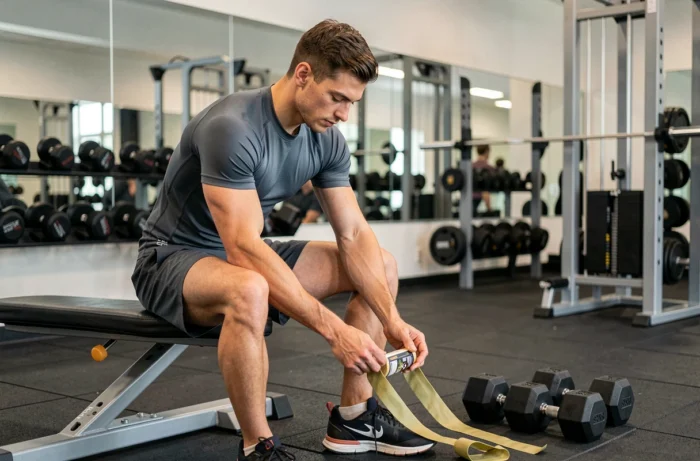
Disposable Equipment vs. Repairable Equipment: The Usage Gaps
An entry-level bike with non-replaceable proprietary components becomes unusable as soon as a derailleur breaks. In contrast, a model equipped with standardized parts can be repaired for a fraction of the cost of a complete replacement.
The same reasoning applies to textiles. A jacket whose heat-sealed seams come apart after a few washes cannot be easily resewn. Favoring classic seams in high-stress areas (shoulders, armholes) prolongs the lifespan of the garment.
Before purchasing, three quick checks can help evaluate repairability:
- Does the manufacturer offer accessible spare parts (soles, laces, pads, screws)?
- Do the main materials withstand regular maintenance without degrading (washing, waterproofing)?
- Are the assemblies mechanical (screws, seams) rather than glued or welded?
Safety and Protective Equipment: Adjusting the Level to the Real Risk
The bike helmet, soccer shin guards, or swimming goggles are not about comfort. They are protective equipment whose role is to reduce the severity of an impact or exposure. A poorly fitted protective equipment offers less protection than a properly sized model, even if the latter is from a lower range.
Size and fit take precedence over price. A helmet that shifts with the slightest head movement does not fulfill its function in case of a fall. A knee brace that is too tight compresses the joint and hinders flexion.
For sports with a risk of impact (cycling, skiing, team sports), checking for the presence of a certification standard on the label remains the only reliable way to distinguish a real protective accessory from a purely cosmetic product.
The choice of sports equipment therefore rests on four concrete axes: the regulatory compliance of the product, the biomechanical adequacy with the practitioner’s profile, the repairability of the equipment, and the proper fitting of protections. Crossing these four criteria before each purchase reduces unpleasant surprises much more effectively than sorting by price or popularity.