
The red “calc” light comes on your Bosch Tassimo, and the pod drawer is empty. We know the situation: the official descaling kit is out of stock, delivery takes three days, and the morning coffee won’t wait. The good news is that you can effectively descale the machine with common products, as long as you choose the right one and follow a precise protocol.
Citric acid or white vinegar: the choice that protects your Tassimo
On forums and blogs, white vinegar is often touted as the miracle solution. In practice, it’s more nuanced. Several manufacturers of pod machines, including Tassimo, remind in their updated manuals that white vinegar can damage internal seals and compromise the warranty of the device.
The problem comes from acetic acid, which is more aggressive on elastomers than citric acid. When vinegar is used regularly, the seals in the water circuit degrade faster, which eventually leads to leaks or alters the taste of the coffee.
Powdered citric acid remains the best non-proprietary alternative to Tassimo tablets. It can be found at drugstores, organic grocery stores, or supermarkets for a few euros per packet. It dissolves limescale without attacking rubber parts or leaving a persistent aftertaste. To successfully descale the Bosch Tassimo coffee maker without a tablet while preserving the machine, this is the route we recommend.
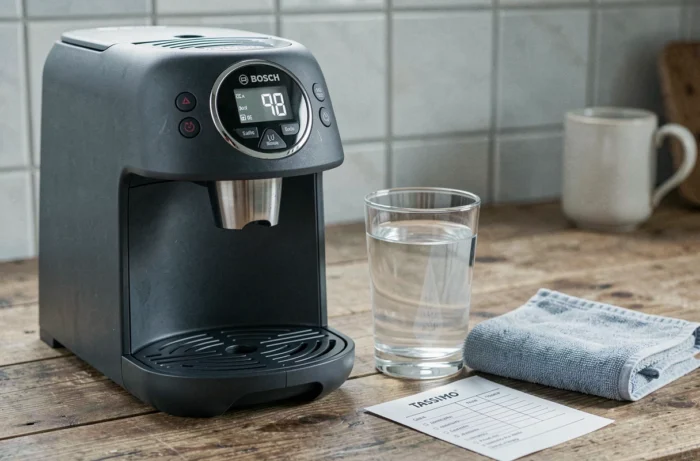
Preparing the descaling solution for the Tassimo coffee maker
The concentration is as important as the product chosen. If too diluted, the solution won’t dissolve the limescale. If too concentrated, it risks saturating the circuit and leaving residues.
Dosage and water temperature
Dissolve one to two tablespoons of citric acid in one liter of warm water (not boiling). Warm water speeds up the dissolution of the powder and enhances its action on limescale, without risking deformation of the plastic parts of the tank.
Stir until completely dissolved. If any grains remain visible at the bottom, they can clog the suction filter of the tank. Take the time to mix well before pouring.
Adjusting frequency to water hardness
If your tap water is hard (you can see white deposits on the kettle or faucet), descaling every month to six weeks is reasonable. With soft water, you can space it out to two or three months. The frequency directly depends on the hardness of your water, not on a fixed calendar.
Descaling Bosch Tassimo without a tablet: the complete protocol
Once the solution is ready, we move on to operating the machine. The process takes about twenty minutes, including rinsing.
- Remove any T-disc from the capsule holder and empty the water tank. Fill it with the prepared citric acid solution.
- Insert the service T-disc (the yellow disc provided with the machine) into the designated slot. If you have misplaced it, keep a used pod emptied of its grounds: it keeps the mechanism in the closed position to start a cycle.
- Place a container of at least one liter under the coffee outlet, then press the start button. Let the machine empty about half of the tank through the circuit.
- Turn off the machine and let the solution act for about thirty minutes in the circuit. This pause allows the citric acid to dissolve the limescale deposits accumulated in the heating element and conduits.
- Restart the machine to evacuate the rest of the solution. The liquid coming out into the container is often cloudy, sometimes slightly colored: it’s the dissolved limescale.

Rinsing the Tassimo machine: the step many neglect
It is often recommended to do “a rinse with clear water.” One cycle is not enough. Two to three cycles of rinsing with fresh water eliminate the residues of citric acid that would give a sour taste to the first coffee.
Empty the tank, rinse it, fill it with cold tap water. Start a complete cycle with the service T-disc (or the empty pod), empty the container, then repeat. On the third pass, the water that comes out should be clear and odorless.
After the last rinse, remove the service T-disc, clean the capsule holder with hot water, and wipe the outlet nozzles with a damp cloth. Dried coffee residues around the puncturer also contribute to altering the taste, and this mechanical cleaning complements the chemical descaling well.
When the red “calc” light refuses to turn off
On some Bosch Tassimo models, the descaling light remains on even after the operation. It is an internal counter, not a limescale sensor. To reset it, hold the start button down for several seconds until the light goes off. Feedback varies on this point depending on the models: on some generations, you need to hold the button for five seconds, on others a bit longer.
If the light persists after resetting, restart a complete descaling cycle. Sometimes the first pass is not enough when the machine hasn’t been descaled for a long time.
What white vinegar really does to the seals of your coffee maker
We return to vinegar because the temptation remains strong. In a one-time emergency, a pass with diluted vinegar won’t destroy the machine. The problem arises with repeated use, cycle after cycle.
Acetic acid attacks silicone and EPDM seals faster than citric acid. Over time, the seals become porous, lose their elasticity, and micro-leaks appear at the capsule holder or heating element. On a machine under warranty, this type of degradation noted by customer service can justify a refusal of coverage.
For an emergency descaling without citric acid on hand, a very diluted white vinegar solution (one part vinegar to three parts water) followed by abundant rinsing remains a lesser evil. But we do not recommend it as a habit.
Regular descaling with citric acid costs a few cents per cycle, preserves the internal mechanics of the Bosch Tassimo, and maintains coffee without an aftertaste. It is the most reliable method when you don’t have an official tablet on hand.