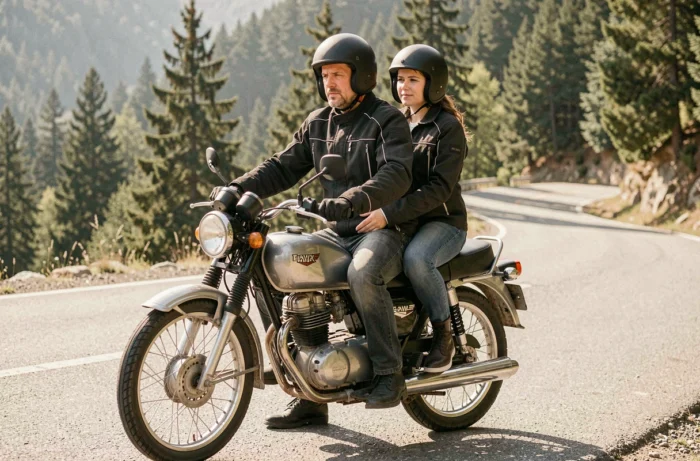
On paper, pairing a 2-stroke engine with a dual-use in 125 seems almost a technical contradiction. The 2T single-cylinder produces its best performance at high revs, where passenger comfort deteriorates. However, we will identify the models and configurations that allow for a balance between the two, starting with what really matters: the chassis, the two-seat ergonomics, and the upcoming regulatory constraints.
ZFE Restrictions and 125 2-Strokes: A Parameter Ignored by Guides
Before comparing models, it is essential to establish a structural fact. Low emission zones will gradually exclude 2-strokes from European city centers. Milan has enacted a ban on access to Area B and Area C for Euro 2 and Euro 3 2-stroke motorcycles and scooters starting October 1, 2027, and for Euro 4 2-strokes starting October 1, 2030.
In France, the ZFE in Lyon, Paris, or Marseille follow a similar trajectory, although the precise timeline for two-wheelers remains uncertain. Therefore, buying a 125 2T for riding two in the city implies accepting a shrinking usage window.
For suburban or road use, the problem has not yet arisen. But anyone considering choosing a comfortable 125 2-stroke motorcycle for two must take this data into account before signing an order form.
Seat, Footpegs, and Ergonomic Triangle: Duo Criteria on a 2-Stroke
Passenger comfort is not limited to the width of the seat. On a 2-stroke, three elements determine whether riding two is feasible beyond thirty minutes.
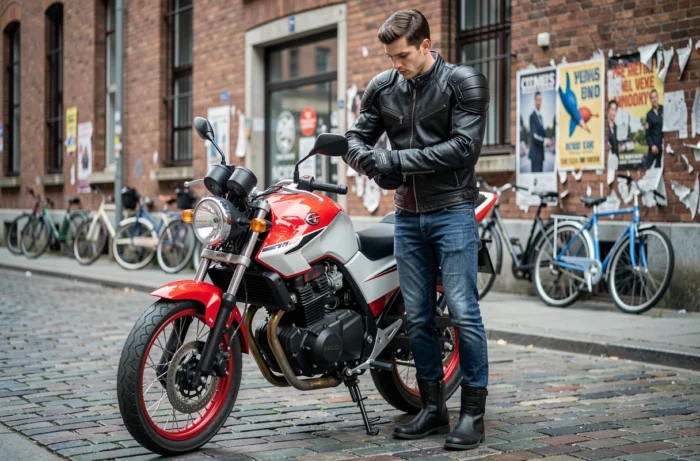
- Seat Height and Length: The passenger section must be at least as wide as the rider section. On sporty 125s like the Aprilia RS 125 or Cagiva Mito, the rear seat is symbolic. It becomes unusable beyond short urban trips.
- Position of Passenger Footpegs: High and rear-set footpegs (typical of supermotards) force the passenger to bend their knees at a sharp angle. The weight shifts onto the rider’s lower back with every braking.
- Frame Rigidity and Wheelbase: A short wheelbase makes the motorcycle twitchy when riding two. The additional weight of the passenger alters the load distribution and destabilizes the front end during braking. A steel trellis frame with a generous wheelbase (beyond the average for sportbikes) is preferable.
We recommend checking these three points on the desired model before consulting the engine specifications. A powerful 2-stroke on a chassis unsuitable for two is worthless in comfort.
125 2-Stroke Models Usable for Two: What Remains on the Market
The new 125 2T market has significantly shrunk with Euro 4 and then Euro 5 standards. The majority of available models are used. Here are the configurations that hold up for two-seater use.
Yamaha DT 125 RE and Road Versions
The DT 125, in its road variants (RE), offers a decent two-seat saddle and a long enough frame to accommodate two. The 2T single-cylinder engine delivers usable torque from mid-revs, which avoids keeping the engine constantly in the power zone. The seat height remains high, which may pose a problem for shorter passengers.
KTM 125 Sting and Older Duke Versions
The KTM 125 Sting, produced in the 1990s, featured a trellis frame and a roadster riding position with properly positioned passenger footpegs. The liquid-cooled 2T engine offered a wider operating range than cross engines. The KTM remains one of the few 125 2Ts designed from the outset for versatile road use.
Cagiva Planet 125
Less known, the Cagiva Planet offered superior two-seat ergonomics compared to the Mito thanks to a flatter seat and mid-position passenger footpegs. The 2T Rotax engine it was equipped with is known for its reliability, but parts are becoming rare.
2-Stroke Engine Maintenance and Specific Constraints for Two
Riding two on a 125 2T significantly increases mechanical stress. The additional weight of the passenger accelerates the wear of the rings and piston. On a 4-stroke engine, the thermal safety margin is wide. On a 2T, the window between suitable operation and seizure narrows.
Three precautions are necessary:
- Adjust the main jet of the carburetor (or the mapping on the rare fuel-injected models) to enrich the mixture under load. A 2T running lean while carrying a passenger overheats.
- Check the oil level of the mixture before each long ride. Consumption increases proportionally with the load.
- Monitor the cylinder head temperature with an additional sensor if the model is not equipped with one as standard. This is an investment of a few dozen euros that can prevent a seizure.
The maintenance of a 2T in dual use costs more in consumables than an equivalent 4-stroke. The price of pistons, rings, and replacement gaskets varies depending on parts availability, but the cost remains higher than that of a 4T single-cylinder Honda or Yamaha of the same displacement.
Insurance and Technical Control: The Regulatory Framework Favorable to 125s
One point works in favor of 125 2Ts: the mandatory motorcycle technical control in France since April 2024 only applies to displacements over 125 cm³. Therefore, 125 owners escape this periodic constraint, which reduces the overall cost of ownership.
On the insurance side, 125 2Ts remain in low tariff brackets. The 2-stroke engine profile does not incur specific additional costs with most insurers, provided the model is not classified as a sportbike (the Aprilia RS 125, for example, sometimes incurs a surcharge).
The combination of no technical control and moderate insurance makes the 125 2T financially attractive, provided that the mechanical maintenance budget described above is not underestimated. The real cost of a 125 2T for two is calculated by adding engine consumables and wear parts, not just insurance and fuel.