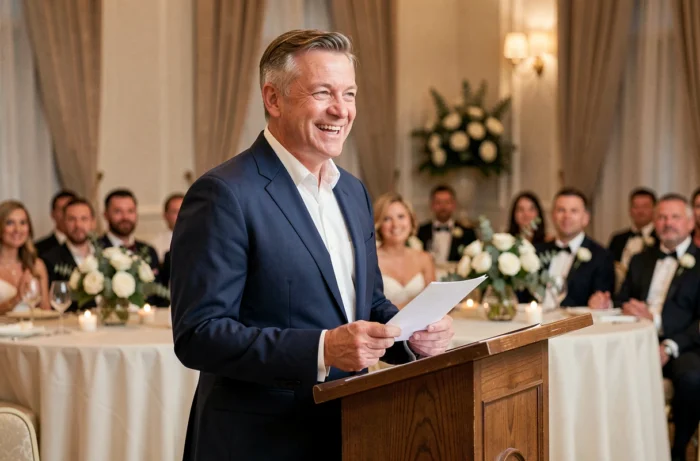
Speaking at your son’s wedding presents a simple paradox: you have twenty or thirty years of memories, but only a few minutes to craft a speech that holds up. The wedding speech for your son follows no fixed protocol, unlike that of the father of the bride, which is historically more codified. This freedom is an advantage, provided you know what to do with it.
Father of the Groom: A Role Without a Script, and That’s a Good Thing
The father of the bride has long had a well-defined role in Anglo-Saxon ceremonies: welcoming guests, expressing thanks, making the first toast. The father of the groom, however, has never had this ceremonial obligation. Several recent sources confirm that this asymmetry persists, but it now plays in favor of the groom’s parent.
Without a mandated script, you choose your angle. You can talk about your son as a child, the first time you met his partner, or simply raise your glass with three sincere sentences. Writing a wedding speech for your son is about deciding what you want to convey, not filling a box.
Are you torn between a long speech and a few words? Opt for brevity: two to three minutes is more than enough. The trend in recent years clearly leans towards shorter speeches to avoid tiring guests between courses. A single well-told anecdote leaves a greater impression than a catalog of memories.
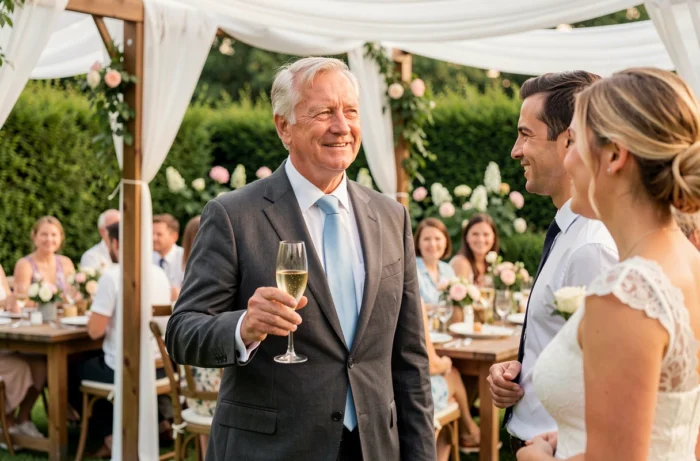
Finding the Right Tone: Three Concrete Speech Registers
The register you adopt depends on your relationship with your son, the atmosphere of the wedding, and your comfort with public speaking. Here are three distinct approaches, each illustrated by an adaptable excerpt.
The Subtle Emotional Register
No need to aim for tears from the entire room. Subtle emotion relies on a specific fact, not on abstract statements. Instead of saying “you have always been brave,” recount the moment when your son did something courageous.
Example excerpt: “When you were eight years old, you insisted on carrying your grandmother’s bag up the stairs at the train station. You were half her size. That day, I realized you would take care of those around you. [Partner’s name], he will take care of you.”
A precise visual anecdote resonates more than a repeated adjective.
The Controlled Humor Register
Humor in a wedding speech works when it is kind-hearted and when everyone can laugh, not just close family. Inside jokes that only three cousins understand create polite discomfort among other guests.
Example excerpt: “My son has always had a talent for negotiation. At five years old, he convinced me that dessert before dinner was a scientifically proven concept. [Name], welcome to the family: you have married a lawyer in the making.”
Successful humor relies on a concrete image, never on mockery.
The Short and Direct Register
Some parents dislike speaking in public. That’s perfectly acceptable, and a speech of less than a minute can be the most memorable of the evening.
Example excerpt: “[Son’s name], your mother and I are proud of you. [Partner’s name], thank you for making him happy. To both of you.”
A short speech is not a rushed speech; it’s a stylistic choice.
Structure of a Groom’s Parent Speech: Four Blocks That Work
Regardless of the chosen register, a simple structure prevents the speech from going in all directions. These four blocks flow naturally:
- The welcome: thank the guests for being present, in one or two sentences. No need to name every table.
- The personal anecdote: a memory that says something about your son. Choose just one, the most visual possible.
- The opening towards the couple: welcome the person joining the family. Talk about a specific moment when you realized this relationship mattered.
- The toast: end with a sincere wish and raise your glass. The wish can be funny, tender, or understated, but it should fit into one sentence.
This structure works in one minute as well as in three. A common mistake is to add a fifth block (life advice, philosophical quote, reflection on one’s own couple history) that dilutes the impact of the first four.
Common Mistakes That Weaken a Parental Wedding Speech
Several pitfalls consistently appear in parents’ speeches, regardless of the intended style.
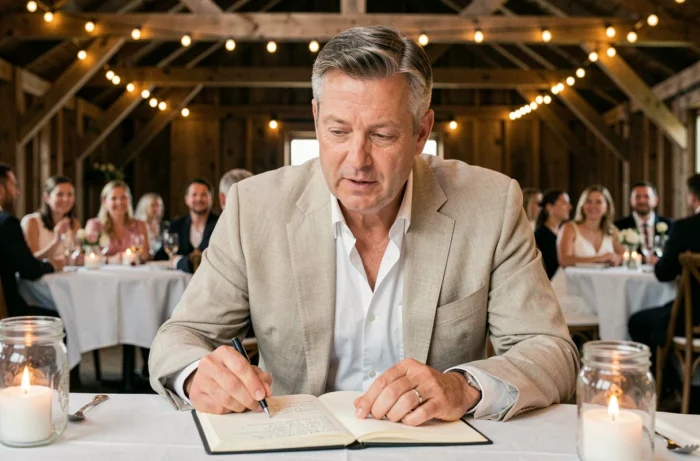
- Reading the text word for word, eyes glued to the page. It’s better to jot down four keywords on a card and improvise around them.
- Mentioning ex-partners, even indirectly. The rule is simple: if the couple doesn’t talk about it, neither should you.
- Stringing together anecdotes without a common thread. Each additional memory after the first diminishes the impact of the previous one.
- Apologizing for your emotions. Crying while speaking is nothing to be embarrassed about. Apologizing for thirty seconds for crying, however, creates discomfort.
The best speech is one you could say to your son in a one-on-one conversation. The room is merely listening to a conversation that already existed. If a sentence sounds false when you read it aloud in your kitchen, it will sound false in front of the guests.
The father or mother of the groom has no official role to fulfill, no tradition to adhere to strictly. Talk about your son, welcome the person he has chosen, raise your glass. The rest is a bonus.