
Transforming an interior doesn’t necessarily require major renovations or a substantial budget. The difference between a mundane space and a place with strong personality often lies in precise choices of shapes, lighting, and furniture arrangement. Three concrete levers allow for a visible result without changing everything.
Curved furniture and rounded shapes: the alternative to overly linear interiors
Straight lines dominate most layouts by default. Orthogonal walls, rectangular tables, cubic shelves: the overall effect tends to produce a visual rigidity that decoration alone cannot compensate for.
Furniture with rounded shapes provides a concrete answer to this problem. A sofa with soft angles, an oval coffee table, or an enveloping armchair change the flow of sight in the room. Curves create a visual fluidity that is lacking in strictly angular compositions.
The most underestimated advantage of curved furniture concerns difficult corners. A dead angle between two walls is much better suited for a rounded console than a straight piece that leaves a triangular void behind it. The shape hugs the space instead of cutting it up. Interior design enthusiasts who regularly explore the home page of News Quirk will find this type of approach reflected in recent trends.
A technical point to keep in mind: curves work in contrast to the rest of the furniture. A living room entirely composed of rounded pieces loses the desired effect. It’s better to introduce two or three curved elements into a predominantly linear environment so that the eye catches the difference.
Zoning an atypical room: dividing the space without partitioning
L-shaped rooms, spaces under eaves, or traversing living areas pose a recurring problem: a classic layout plan doesn’t work. Pushing all the furniture against the walls and centering a rug is not enough to give coherence to a room with irregular geometry.
Zoning involves creating several distinct functional areas within the same volume. Each zone has a clear use (reading, dining, working) and is distinguished by a visual element: a rug, a change of lighting, or simply the orientation of the furniture.
Floating furniture away from the walls
The most effective technique for zoning an atypical space is to detach certain pieces of furniture from the walls. A sofa placed in the middle of an L-shaped living room naturally separates a relaxation area from a dining space, without walls or screens.
- A buffet positioned perpendicular to the wall creates a visual separation between the open kitchen and the living room, while providing storage on both sides.
- A narrow console placed behind a floating sofa delineates a passage and serves as a surface for lamps or objects.
- A generously sized rug, placed under the sofa-coffee table group, visually anchors the conversation area and distinguishes it from the rest of the room.
This principle works even in small spaces. Zoning requires no more square meters; it requires more thought about the layout.
Scenographic lighting: changing the atmosphere of a room without touching the walls
The majority of French interiors still rely on a central ceiling light that diffuses uniform light. This approach provides adequate illumination but flattens volumes and creates no depth.
Scenographic lighting is based on a different principle: multiplying light sources at various heights and adapting them to the use of each zone. A reading lamp near the armchair, a LED strip under a shelf, a low pendant above the dining table produce a play of shadows and light that transforms the perception of space.
Three light heights for a balanced living room
The most reliable practical rule is to distribute the sources at three levels. At height, a discreet pendant or ceiling light provides general illumination. At mid-height, wall sconces or lamps placed on furniture illuminate activity areas. On the floor, an adjustable floor lamp or indirect lighting behind a low piece of furniture creates depth.
Varying color temperatures enhances the effect. A warm light in the relaxation corner and a more neutral light on the work surface are enough to differentiate two atmospheres in the same room, without any intervention on the walls or furniture.
High-impact decorative details: handles, frames, and corner plants
Some elements cost little but significantly change the perception of a room. Recent content on interior decoration highlights these transformative details, often overlooked in favor of more imposing furniture pieces.
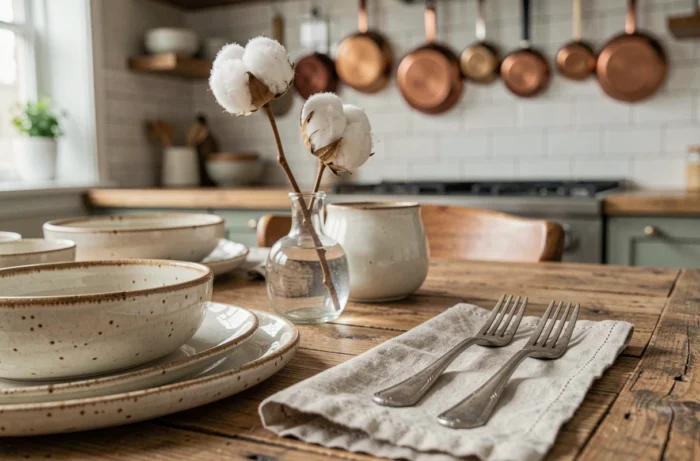
Changing cabinet handles in a kitchen or dresser takes just a few minutes. Brushed brass handles on a white piece of furniture, or ceramic knobs on a wooden wardrobe, are enough to alter the perceived style of a piece without replacing it.
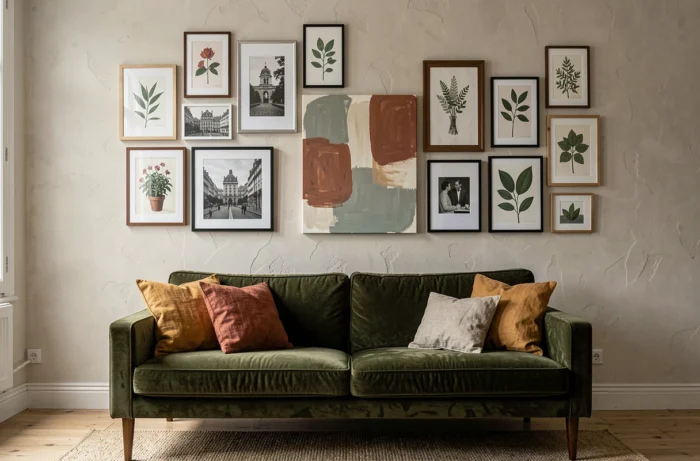
Framed prints and wall compositions are another quick lever. A series of three frames in different sizes, aligned on the same horizontal axis, structures an empty wall better than a large isolated painting. The choice of the frame is as important as the image it contains.
Corner plants solve both a practical and decorative problem. An empty corner between two pieces of furniture immediately gains volume with a tall plant. The foliage breaks the rigidity of the surrounding lines and adds an organic texture that furniture alone cannot replicate.
Transforming an interior rarely relies on a single spectacular gesture. It is the combined decisions regarding the shape of the furniture, the arrangement in space, the quality of the lighting, and the choice of details that produce a coherent result. A well-placed rounded sofa, two additional light sources, and new handles change the atmosphere of a living room more than a trendy wall paint applied without consideration of the rest.