
A homeowner who expands their attic or closes a veranda often discovers the discrepancy between the actual area of their property and what the tax authorities have recorded. This discrepancy directly affects property tax and, in some cases, the housing tax for secondary residences. Understanding what area the tax office considers, and how to verify it, helps avoid overpaying or underpaying.
Weighted area and cadastral rental value: what the tax office really calculates
We often talk about living space, but the basis for property tax assessment relies on another concept: weighted area. The administration starts with the actual area measured on the ground between walls or separations, rounded down to the nearest square meter. Then, it applies correction coefficients related to comfort and characteristics of the property.
These coefficients take into account the existence of a garage, a balcony, sanitary facilities, central heating, or the state of maintenance. Two houses of identical size in the same municipality can therefore have very different cadastral rental values, simply because one has a covered outbuilding and the other does not.
To find out how to know the actual area for taxes, one starts by obtaining their cadastral evaluation sheet from the property tax office. This document details the area considered, the category of the premises, the comfort elements taken into account, and the weighting calculation. It is the only document that allows comparing what the tax office has recorded with the reality on the ground.

Cadastral evaluation sheet: request and read the right document
The cadastral evaluation sheet does not spontaneously appear in the “Manage my real estate” section on impots.gouv.fr. It must be requested, either by mail to the property tax center to which the property belongs or directly at the counter.
What the sheet contains
- The actual area declared by the owner (or measured during construction), measured on the ground between walls
- The weighting coefficients applied: nature of the rooms, equipment, geographical location of the property within the municipality
- The category of the premises (from 1 to 8 for residences), which reflects the standing estimated by the administration
- The details of the outbuildings attached to the main lot (garage, cellar, shed, pool)
Sometimes, there are consistency errors dating back to the initial construction. An unconverted attic counted as living space, a cellar converted into a laundry room that was never reported, or a garage converted into a bedroom without declaration: each discrepancy between the tax description and reality distorts the tax base.
Check consistency with a ground measurement
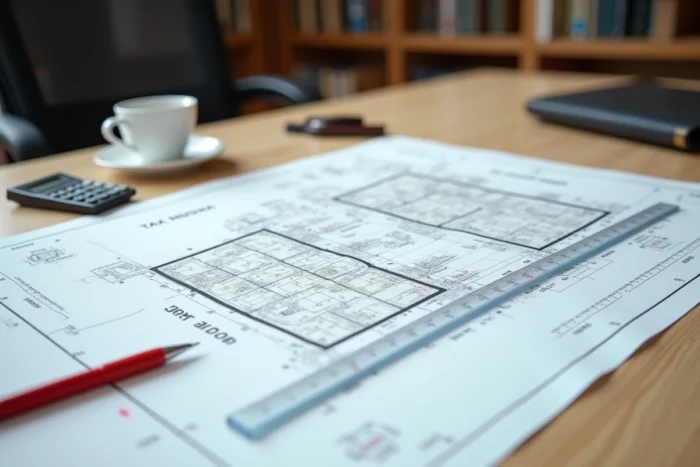
Measuring each room on the ground between walls, excluding portions under a ceiling lower than the threshold set by the Building Code, provides a first basis for comparison. If the discrepancy with the area recorded on the sheet is significant, you have a solid reason for a claim.
Correcting an error in the area declared for taxes
When the area retained by the tax office does not correspond to reality, the owner can request a tax reduction. The process involves a contentious claim addressed to the property tax office, accompanied by supporting documents.
Documents to gather to support the request
- Dimensioned plans of the property, ideally prepared by a diagnostician or surveyor
- Surface diagnosis (Carrez law for a condominium unit, or free measurement for a single-family home)
- Datable photos of the affected rooms, especially if an outbuilding has changed nature or if the attic is not converted
- Any document proving the actual consistency: building permit, prior declaration of works, sales deed mentioning the area
The administration then has a period to process the claim. In case of rejection, an appeal to the administrative court remains possible, but this enters a longer procedure.
The trap of under-declaration
Correcting an overestimated area lowers property tax. Conversely, an under-declared area exposes one to reassessment with back taxes over several years. An owner who has converted an attic, closed a porch, or created an extension must declare the change in consistency within 90 days of the completion of the work, using the appropriate form (there are several depending on the nature of the change).
Living space, Carrez area, tax area: do not confuse the concepts
The confusion between these three measurements is common, and it generates declaration errors.
The living space (Building Code, article R. 111-2) excludes walls, partitions, steps, door and window frames, as well as parts with a ceiling height below the regulatory threshold. It serves as a reference for residential leases.
The Carrez area measures the enclosed and covered floors of a condominium unit, excluding areas with ceilings that are too low. It does not apply to single-family homes outside of condominiums.
The tax area retained for the rental value is measured on the ground between walls, without excluding interior partitions. It is therefore systematically larger than the living space. This difference surprises owners when they compare their surface diagnosis with the tax data.
Confusing living space and tax area amounts to declaring an area smaller than what the administration expects. It is better to identify the correct measurement method before filling out a change declaration form, to avoid back-and-forth with the tax office.
Feedback from owners who have contested their weighted area varies on this point: some obtain a quick correction after sending dimensioned plans, while others must follow up several times before the file is processed. Keeping a copy of each exchange and sending the claim by registered mail remains the most reliable precaution.